Mostrando postagens com marcador Space. Mostrar todas as postagens

segunda-feira, 16 de setembro de 2013

Voyager 1 embarks on historic journey into interstellar space

September 13, 2013


NASA‘s Voyager 1 spacecraft is now officially the first human-made object to venture into interstellar space. The 36-year-old probe is about 12 billion miles (19 billion kilometers) from our sun.

New and unexpected data indicate Voyager 1 has been traveling for about one year through plasma, or ionized gas, present in the space between stars.

Voyager is in a transitional region immediately outside the solar bubble, where some effects from our sun are still evident.

“Now that we have new, key data, we believe this is mankind’s historic leap into interstellar space,” said Ed Stone, Voyager project scientist based at the California Institute of Technology, Pasadena.

“The Voyager team needed time to analyze those observations and make sense of them. But we can now answer the question we’ve all been asking — ‘Are we there yet?’ Yes, we are.”

Voyager 1 first detected the increased pressure of interstellar space on the heliosphere, the bubble of charged particles surrounding the sun that reaches far beyond the outer planets, in 2004.

Scientists then ramped up their search for evidence of the spacecraft’s interstellar arrival, knowing the data analysis and interpretation could take months or years.

NASA placed a kind of time capsule on Voyager 1 and 2-intended to communicate a story of our world to extraterrestrials. The Voyager message is carried by a phonograph record — a 12-inch gold-plated copper disk containing sounds and images selected to portray the diversity of life and culture on Earth. (Credit: NASA JPL)

Scientists do not know when Voyager 1 will reach the undisturbed part of interstellar space where there is no influence from our sun. They also are not certain when Voyager 2 is expected to cross into interstellar space, but they believe it is not very far behind.


For a sound file of the oscillations detected by Voyager in interstellar space, animations and other information, visit: http://www.nasa.gov/voyager and http://www.jpl.nasa.gov/interstellarvoyager/.

For an image of the radio signal from Voyager 1 on Feb. 21 by the National Radio Astronomy Observatory’s Very Long Baseline Array, which links telescopes from Hawaii to St. Croix, visit: http://www.nrao.edu/.


Source: http://www.kurzweilai.net/voyager-1-embarks-on-historic-journey-into-interstellar-space

quinta-feira, 27 de setembro de 2012

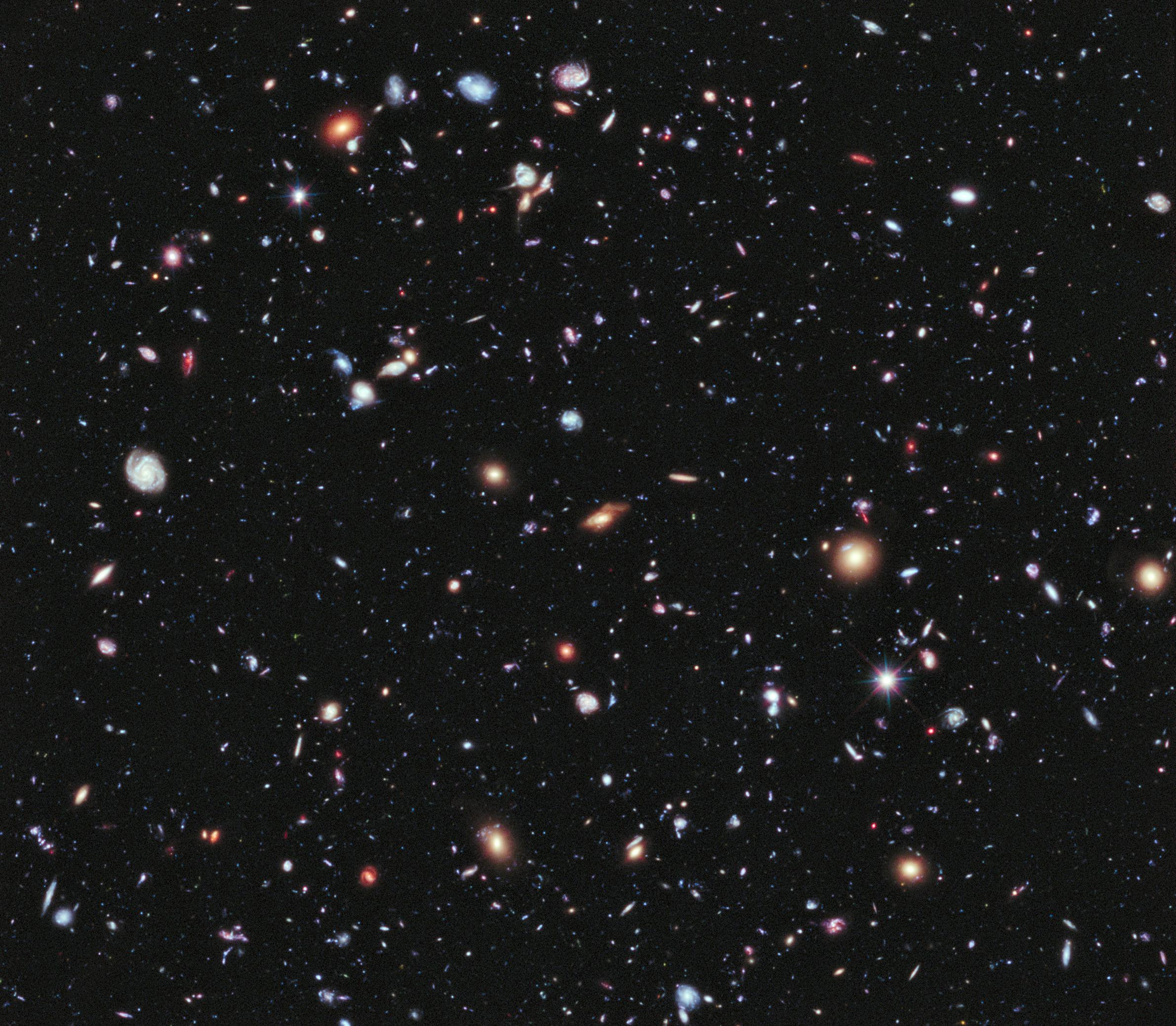
The Hubble´s eXtreme Deep Field (XDF) - NASA image release September25, 2012

Like photographers assembling a portfolio of best shots, astronomers have assembled a new, improved portrait of mankind's deepest-ever view of the universe.

Called the eXtreme Deep Field, or XDF, the photo was assembled by combining 10 years of NASA Hubble Space Telescope photographs taken of a patch of sky at the center of the original Hubble Ultra Deep Field. The XDF is a small fraction of the angular diameter of the full moon.


Read and see more: http://goo.gl/t7fG2

Download the original size of this photo (Creative Commons license):
http://farm9.staticflickr.com/8032/8024062104_b2a6602149_o.jpg

quinta-feira, 10 de maio de 2012

ESA declara fim da Missão Envisat

Poucas semanas depois de comemorar seu décimo ano em órbita, a comunicação com o satélite Envisat foi subitamente perdida em 8 de Abril. Após rigorosas tentativas de restabelecer o contato e a investigação de cenários de falha, foi declarado o fim da missão.


Uma equipe de engenheiros passou o último mês tentando recuperar o controle do Envisat, investigando as possíveis razões para o problema. Apesar dos contínuos comandos enviados de uma ampla rede de estações terrestres, não houve nenhuma reação do satélite.
Envisat (impressão artística). Fonte: ESA.
Como não houve nenhum sinal de degradação antes da perda do contato, a equipe tem recolhido outras informações para ajudar a compreender a condição do satélite ‒ entre estas, imagens de radar terrestre e do satélite francês Pleiades.


Com essas informações, a equipe tem gradualmente elaborado cenários de falha possíveis, entre eles a perda do regulador de potência, o que bloquearia a telemetria e telecomandos.

continuar lendo: http://goo.gl/c3cBc

quinta-feira, 13 de maio de 2010

Spaceflight Now | STS-132 | Mission Status Center

Spaceflight Now | STS-132 | Mission Status Center
Welcome to Spaceflight Now's live coverage of space shuttle Atlantis' STS-132 mission to the International Space Station. Text updates will appear automatically; there is no need to reload the page.

quarta-feira, 12 de maio de 2010


Neil Armstrong on the Moon from Mark Gray on Vimeo.

This enlargement of an HD transfer of the 16mm film taken from the Lunar Module Eagle, shows Armstrong working on the moon to take the contingency sample a short time after first walking on the surface.

Tales From Future's Calendar